Home › Road, Street, and Municipal Paving
Reliable, professional road paving in New Orleans, LA from Precision Asphalt New Orleans. Contact us today for a free on-site estimate.
Precision Asphalt New Orleans provides professional road paving throughout New Orleans, LA, Louisiana and the surrounding area. Our licensed, insured crew delivers safe, clean, on-time work with a free estimate before anything begins. Call (504) 499-0348 or request your free quote.
Road, Street, and Municipal Paving in New Orleans
Road paving in New Orleans is not just about putting down blacktop. Our streets sit on soft, often saturated soils, see intense rainstorms, heavy traffic, and recurring utility work. Precision Asphalt New Orleans designs and installs pavement systems that are built for this specific environment so your roadway lasts longer and requires fewer emergency repairs.
We handle public streets, subdivision roads, industrial access roads, school drive lanes, and private roadways that must meet municipal standards. From initial evaluation through final striping, our team focuses on stability, drainage, and smooth traffic flow, not just a quick overlay. That careful planning is what keeps your pavement from rutting, alligator cracking, or holding water after a typical New Orleans downpour.
Whether you manage a neighborhood HOA, a small municipality, a plant or port facility, or a commercial property with internal streets, Precision Asphalt New Orleans can help you choose the right structure, thickness, and maintenance plan for your roads so they perform in our Gulf Coast climate.
How We Design Roads That Work in New Orleans Conditions
Good road paving starts long before trucks arrive with hot mix. Our crews begin with a site visit to document existing pavement distress, drainage patterns, and utility locations. In New Orleans we pay close attention to pumping (mud coming up through cracks), edge failures where the shoulder is soft, areas where water consistently stands, and any signs of base movement from our soft subgrade soils.
Next, we determine whether a full-depth reconstruction, asphalt overlay, or mill and overlay is appropriate. Older streets with widespread base failures or serious rutting typically need full-depth work. Streets with a sound base but weathered or cracked surface may be good candidates for milling off the top layer and installing a new asphalt surface. We often core the pavement or test the base to verify thickness and condition before recommending a solution.
We also factor in expected traffic loads and turning movements. Residential streets that carry cars and garbage trucks can often use a different mix and thickness than truck routes serving port, industrial, or commercial districts. Precision Asphalt New Orleans follows Louisiana DOTD standards as a guide for asphalt mix types, lift thicknesses, and compaction targets, then adapts to your specific site and budget.
Finally, we plan for drainage. In a low-lying city, getting water off and away from the pavement is critical. That might mean adding or reshaping gutter lines, correcting cross slope, or coordinating with your engineer to improve catch basin locations or elevations before we pave.
Step-by-Step: Our Road Paving Process
Once the design is set, road paving follows a controlled sequence so the finished surface is strong and smooth.
1. Traffic control and notifications: For public streets or busy private roads, we provide or coordinate traffic control plans, cones, signs, and flaggers as needed. Residents and businesses are given clear schedules so they know when access will be limited.
2. Removal and subgrade preparation: We mill or excavate the existing pavement to the required depth. Any soft or pumping areas are undercut and replaced with stable material, such as crushed limestone or recycled aggregate, then compacted to a specified density. In New Orleans, this step is crucial because of our soft, moisture-sensitive soils.
3. Base installation: Depending on the design, we install a limestone or cement-treated base. On municipal projects we match the city or parish specification. The base is graded to establish the crown and drainage, then machine compacted and proof rolled to verify stability. Any deflection spots are reworked before paving.
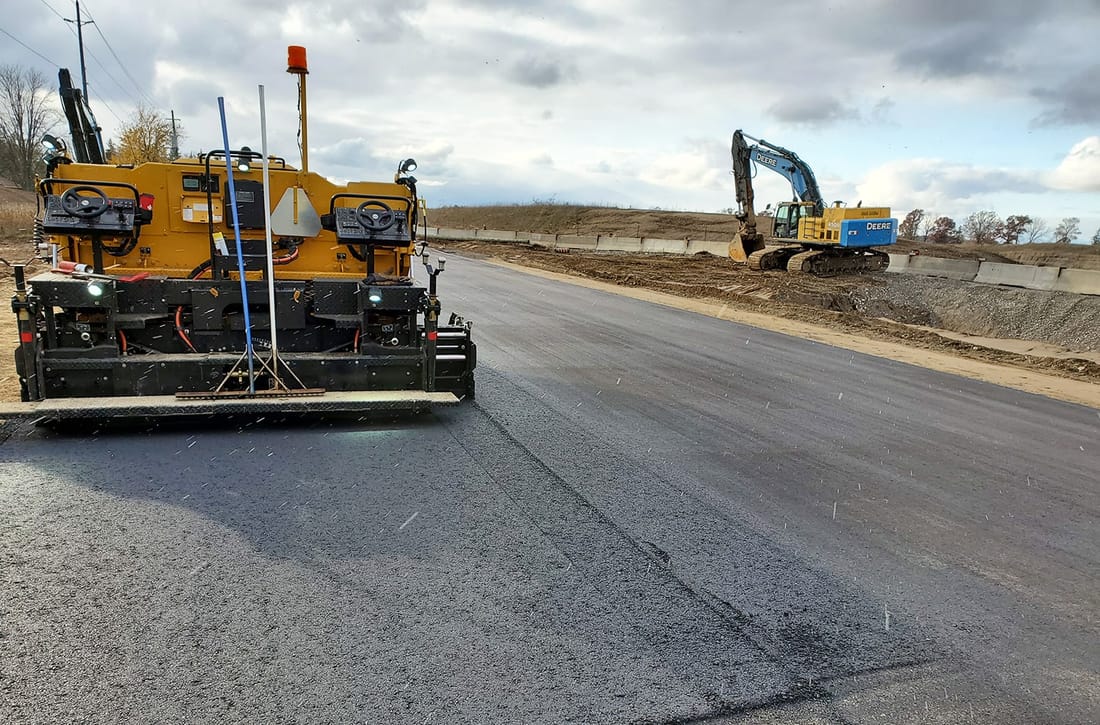
4. Asphalt placement: Asphalt is delivered hot from a local plant and placed with a paver in one or more lifts. Typical residential streets may receive 2 to 3 inches compacted thickness, while heavier routes may receive multiple lifts totaling 4 inches or more. Our crews use steel drum and pneumatic rollers to achieve proper density and a tight, uniform finish at manholes, inlets, and tie-ins.
5. Transitions and joints: We carefully tie new work into existing streets, driveways, and intersections to avoid bumps and water traps. Longitudinal and transverse joints are staggered and compacted correctly to prevent premature cracking along seams.
6. Striping and traffic control devices: Once the asphalt cools, we install or refresh lane lines, crosswalks, stop bars, and symbols using DOTD-compliant paint or thermoplastic as required. We can also install speed humps, rumble strips, and raised markers where approved.
Material Options and What Affects Road Paving Costs
Every paving project in New Orleans is unique. Precision Asphalt New Orleans explains your options clearly so you understand what you are paying for and how it affects performance.
Asphalt mixes: For most streets we use hot mix asphalt designed for Gulf Coast conditions, often with polymer or performance-graded binders that handle our heat and stop-and-go traffic. Heavier truck routes may use a stiffer surface mix over a stronger base course. For low-speed residential streets, we can sometimes use a more economical mix without sacrificing durability.
Section thickness: Thicker asphalt and base layers cost more upfront but usually reduce long-term patching and overlay needs. For example, upgrading from 2 inches to 3 inches of asphalt on a neighborhood street may add some initial cost but can significantly extend service life, especially where garbage trucks and delivery vehicles are frequent.
Site conditions: Poor subgrade, limited access, close quarters, and extensive handwork all increase costs. In many older New Orleans neighborhoods, narrow streets and existing brick or historic elements require smaller equipment and slower production. We factor this into our estimates so there are no surprises.
Drainage and utility coordination: Adjusting manholes, valve boxes, and catch basins, or correcting ponding problems, adds labor and materials but pays off in fewer potholes and less base damage. Since our city utilities are often shallow and irregular, careful adjustment and protection work is part of most projects.
Scheduling and phasing: Working nights or weekends to minimize disruption, or phasing a project to keep access open, can affect price but may be necessary for hospitals, schools, or busy commercial corridors. We work through these options with you during planning.
Common New Orleans Road Problems and How We Address Them
Local streets across New Orleans share a familiar set of issues: potholes that return after every rain, sections that feel like a washboard, and low spots that hold water for days. These are not random. They are symptoms of structural, drainage, or utility problems hidden under the asphalt.
At Precision Asphalt New Orleans, we do not simply cover over issues. When we see repeated potholes in the same area, we investigate the base, subgrade, and nearby utilities. If a leaking water or sewer line is undermining the road, we work with the utility or your engineer to fix the problem before paving. When rutting appears in wheel paths, we review traffic patterns and may specify a stiffer mix or thicker structure.
Settling along the edge of the road is another frequent issue, especially where there is no curb or where shoulders are soft. To combat this, we can reinforce edges with added base, stabilized shoulders, or full-depth asphalt at critical locations. This keeps the pavement from breaking off at the sides when vehicles drive or park near the edge.
Standing water is particularly destructive in our climate. Even a well-built road will fail early if water is allowed to sit on the surface or infiltrate through cracks into the base. When we resurface or reconstruct, we re-establish proper crown and cross slope, improve tie-ins to driveways and side streets, and can integrate minor drainage improvements to get water off the pavement faster.
We also help owners and agencies develop maintenance strategies that extend pavement life. Crack sealing, localized patching, and timely thin overlays can delay the need for complete reconstruction by many years, which is especially important when budgets are tight.
What New Orleans Clients Should Know Before Hiring a Paving Contractor
Choosing a road paving contractor in New Orleans is about more than price. Roads are long-term infrastructure, and mistakes are expensive to correct. Precision Asphalt New Orleans encourages you to look for a partner who understands local soils, drainage, and municipal requirements, not just someone with a paver.
First, ask how the contractor evaluates the existing road. A quick drive-by and a one-page quote usually mean they are guessing. You should expect questions about traffic loads, utility issues, drainage complaints, and any prior repairs. For larger projects, coring or test pits are a sign that the contractor is serious about designing the right solution.
Second, confirm familiarity with local standards. City of New Orleans, Jefferson Parish, and nearby jurisdictions all have specifications for base materials, asphalt mixes, and construction methods. Your contractor should be able to reference and follow these, especially when the road must be accepted by a public agency.
Third, insist on a written scope that covers preparation, base work, asphalt thickness by lift, compaction targets, drainage adjustments, and striping. This makes it easier to compare proposals and avoids misunderstandings later. We provide detailed scopes and are happy to walk them with you on site so everything is clear.
Finally, consider long-term support. A contractor who will be around to handle warranty issues, future patches, or additional phases adds real value. Precision Asphalt New Orleans maintains ongoing relationships with HOAs, facility managers, and municipalities throughout the region and treats each project as a multi-year partnership, not a one-time job.